Monday, 22 March 2010

Happy apping

Recently I've been trying out knitting apps for my iPhone. For anyone with an iPhone, tap 'knitting' into the search box and an array of options appears. In fact, if any more proof that knitting is trendy were needed, then the number of knitter-friendly clever pieces of software for Apple's little block of cool is surely it.

Of course they all claim to help you keep track of your projects, plan your next, count all your stitches and rows and make endless cups of tea (OK, I made up that last one). Prices range from free to £3.49. But which is best? Well that partly depends on what you want the app to do. Jknit, the most expensive, claims to be a complete knitting assistant, allowing you input your pattern instructions to create a single counter telling you exactly what to do row by row – it seems to do everything but knit the rows for you. At the other end of the scale are the free apps that just work as a digital row counter.

The knit test
I've been trying out two of the simpler apps – KnitMinder and Knit Counter, both in free 'lite' versions. The full versions cost £1.79 and £2.39 respectively. Both of these store counters and project information about yarn and needles used.

KnitMinder allows you to record notes in a logbook, which Knit Counter has space for notes. So far so similar. So what are the differences? KnitMinder has the option of saving planned, finished and on hold projects; handy for shopping excursions or keeping track of what you've got outstanding.

The free Knit Counter only allows you record one project; the paid-for version allows unlimited. So while you can't file projects as 'planned' or 'on hold' you can still input such projects and make a note of their status.

Changing boons
Knit Counter's real strength, though, lies in the versatility of its counters. You can assign each project as many counters as you like; for example, a hat I'm making has got four counters. You can assign any name you want to each counter, unlike KnitMinder, which gives you a choice of several. I'm recording the number of rows I knit, the number of repeats in a row, the number of rows to repeat for the ribbing and the number of repeats for the lace section, each with its own name.

To count up, you simply tap on a plus sign next to the row name. You can even link rows so that after you've reached a certain number on one counter, another will count up. Very useful! You can also program in an increase or decrease reminder.

You might have guessed that I prefer Knit Counter. Its adaptability makes it incredibly useful, and the user interface is much prettier than KnitMinder's. It has made following my rather complicated hat pattern much easier. The only drawback is that the free version only lets me record one pattern – so I guess I'll be forking out for the paid-for counter then!

Thursday, 18 March 2010

All hail crochet!

In the latest issue of Knitting (April 2010), Laura 'Purl Princess' Parkinson makes an excellent case for knitting as the king of crafts. Have you read it? The Princess of Purl certainly has a good argument - that knitting is the most portable and sociable of crafts. But, I fear, she has forgotten crochet, knitting's oft-maligned cousin.

Portability
Crochet is just as easy to shove in a bag as knitting. Easier in fact - just one, small hook and a ball of wool is all you need. That one hook makes it a lot better for doing in cramped spaces, like public transport, too; you're much less likely to elbow any fellow travellers (or is that just me?).

I have a project on the go that I only do when on the train or during lunch at work. A throw made up of around 70 'wagon wheels', it's ideal for just keeping in my bag and doing whenever I've got a spare moment. What's more, in my head it doesn't count as one of my WIPs. Because it's specifically for what would otherwise be 'dead' time. I don't know how this means it doesn't count as a WIP, it just doesn't.

Sociability
Like knitting, crochet is a series of stitches repeated, and once you've got that series stuck in your head it's easy to two things at once: watch TV and crochet, chat with friends and crochet, drink wine and crochet. In fact if I could convince one person to hold my book at eye level, turning pages when I nod my head, and another to hold a wine glass at hand level, I could easily combine my three favourite things!

And another thing
Knitting can be slow-going. You can only add to it one row at a time. But crochet, with its trebles and more grows much more quickly.

So, ladies and gentlemen, I give you crochet: the true king of crafts!

This is my latest crochet project: a baby blanket for an old work colleague. These pictures aren't very good. The light in my flat is pretty poor for photography. But you get the idea. I've got a couple more rows to go and then it's the border.


Above: blanket with Knitting. Below: close up of blanket to show stitch pattern. The colour is closer to the photo above; it's actually a very pale pink, for a baby girl.

Thursday, 14 January 2010

Slow coach

Why oh why does it take me so long to finish anything? I'm still, yes still, working on both the lace shrug and the cable tunic. I had to undo quite a lot of the tunic because I'd got the measurements wrong, but even taking that into account it's taking ages to finish both of these.

The shrug was started in November 2008. Which means it's been going on for more than a year now. I think the tunic was started slightly later. Even so, that's still been on the needles for around a year. The tunic is particularly galling, first for the unravelling, second because it's all rib from here on in and it's got me bored rigid and third because despite working on it over Christmas I seemed to hardly do any. In the same time read three books. I just want the damn thing finished now!

I wonder - am I losing interest in the fun new hobby of mine? I've only been knitting and crocheting for two and half years, but maybe I've run out of steam. And yet I still get so excited about new projects. I love the idea of knitting, but the reality is somewhat different. I know the problem: I'm too slow, something about the way I knit means it's taking me far too long to get anywhere. But I haven't the faintest idea how to speed things up.

I did manage one thing - I was sliding the knitting far too far down the needle every time I made a stitch, so I'd have to slide it all way up again, and then way down again, with the next stitch. Well I stopped that, and it did speed me up a bit. But nowhere near enough.

So the question is: how do I go about getting quicker? You'd think it's a matter of practice, and yet despite my two-and-a-half-year's experience I'm really not speeding up. There people out there who can knit jumpers for a family of four and still have time to crochet a new pair of curtains in the time it's taken me to nearly finish one tunic, so I must be doing something wrong. But what? Answers on a postcard please!

I'll post some photos of the tunic when I get home this evening.

Thursday, 8 October 2009

The place for lace

Review: Amazing Crochet Lace by Doris Chan

This isn’t a new book – in fact it’s about three years old, but it’s new to me. I got it as a birthday present just a couple of weeks ago.

The book starts with an introduction from Chan – why she crochets, her theory of ‘exploded’ lace and a bit of advice on how best to approach the patterns. Then it’s the usual abbreviations and stitch keys and then straight into the patterns. There are 19 of them in total, arranged into four chapters with names like Garden Party and Last Call, which seem to have more to do with the names of patterns rather than the look of any of the garments.

First things first, then, exploded lace means taking a pattern for some small decorative item – like a doily or table runner – and adapting it for bigger yarn, bigger hooks and a much, much bigger product, like a shawl, a t-shirt or a dress.

Chan also talks about every crocheter’s most hated stage – the foundation chain. She uses something she calls the BASE CH/SC. It involves making two chains and making both a chain and a single crochet into the first chain. Then doing the same into the chain of the stitch you just made, and repeating this till you’ve got the right number of stitches. It’s something I’ve never encountered before and the instructions and illustrations really are clear. With a bit of practice it was pretty simple. The resultant chain is an odd-looking bulky thing that is remarkably easy to crochet into. I’m not sure it’ll take over from a traditional chain in my crochet repertoire, but it’s certainly good to know.

The pattern I tested was Chrysanthemum Tea Shawl, a huge circular shawl adapted from three doily patterns. The instructions are easy to follow and the thick yarn and big hook mean the piece grows pleasingly fast. Each pattern comes complete with full written instructions and chart showing a sample of the lace pattern.

The garments, which include a skirt, a dress, t-shirts and shawls, are all lovely, with only a couple I wouldn’t wear. The layout and instructions are generally good, clear and simple to follow. But make no mistake, these pieces are not for the beginner. The patterns are complex, often involving hundreds of stitches. To do this you need the time and space to concentrate – don’t do what I did and sit down in front of Smallville and think it’ll turn out OK. It won’t. And make sure you check for errata before you start. I found a mistake in the special stitches box! But think how much worse it would be to have completed a few hundred stitches only to realise something’s wrong.

One problem is the photography. Each garment has a full-page plate and often another couple of photos. But these are all dark, making it difficult to see colours and detail. A little lightening in Photoshop would have helped. But this really is a minor niggle in an otherwise excellent collection.

A couple of not-very-good shots of the shawl.


Thursday, 24 September 2009

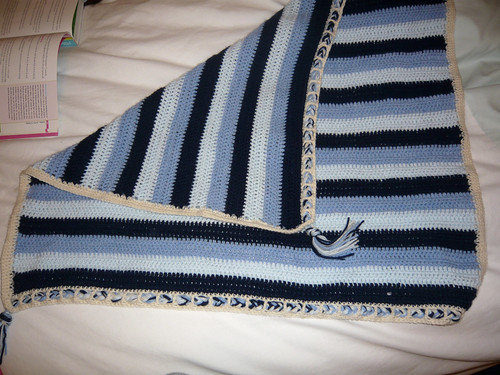
Baby blankie

When I finished this about a week ago I thought I really didn't have anything much to blog about. It's a baby blanket, for a friend's soon-to-be baby - what can be said about that? But then I remembered I didn't use the suggested yarn, so I had to Do Maths. And that's definitely something to write about.

It was simple enough to make - square and in long stripes, double (US) or treble (UK) crochet throughout. The yarn give was a worsted weight though, which we don't get in the UK. The closest we have is aran, but I couldn't find any in the colours I wanted. So I decided to go with DK. And that's where Doing Maths came in. I duly made up a tension square and worked out that I needed half again as many stitches for the length and rows for the width. Rather surprisingly I thought; I'd expected to have to double up on everything. A neat lesson there on why a tension square is so important!

It all went swimmingly well until I got the border - surely a double crochet wasn't going to be long enough to weave the braid through? After a couple of tests I settled on triple. Incidentally another break from the pattern was that I chose a different colour for the border rather than use one of the blues as per the pattern. Another problem came with the braid - the thinner yarn meant many more strands, but how many. Again with some experimentation, I worked it all out. I had to braid the yarn by holding it in my teeth!

I think it turned out OK - judge for yourself:

Wednesday, 22 July 2009

In a twist

I might not rock at lace, but I'm undoubtedly the queen of cables. To take my mind of the shruggle I started on a cable tunic a while back. The back is finished and I've started on the front - I stopped at that point to go back to the shruggle, but as soon as I've finished the left front of that I'll swop back to the tunic.

The yarn for this is a cotton/acrylic mix. It's lovely to knit with and the stitch definition is great. It's worked really well for the cabling. The yarn given was a cotton, which I think would have turned out much heavier and probably not as cosy.

The yarn for the whole thing cost about £20 - £20 for a handmade cabled tunic! Which just goes to show that knitting doesn't have to be an expensive hobby.


Here's tunic! That's the completed back and the start of the front. I'm really hoping I get it finished in time for the cooler weather.


And here's the close up. Look at those cables! Look at that stitch definition! Cables rock.

The ongoing shruggle

Yes, that's right - I'm still at it. I started this in November last year and it's still going strong. Or should that be wrong?

Actually, though, I have improved no end. The back is complete and I've nearly finished the left front, and between now and November I did knit the back of a cabled tunic. So it's not too bad, I guess. I've definitely learnt a lot - such as don't knit with Kid Silk Haze, learn how to read charts before you start using them, lace is really, really hard. I also know what the stitches are supposed to look like so I know when I've gone wrong sooner. I understand where I've gone wrong too, which means my next lace project should be much easier. And yes, there will be a next lace project.

I might even do Cobweb again. But I don't think I'd do it in KSH. While it's light as air and pretty as the sea, it's a bugger to knit with and the stitch definition ain't great. But it's for my mum and she loves KSH, and that's the main thing. I think maybe a 4-ply mercerised cotton knitted up on larger needles would work quite well.


Here's the back and left front. The eagle-eyed among you might notice there's a small mistake in the lace. When I noticed it I decided it was far too late to rip it back. Besides, it's the mistakes that make it unique.


And here's a close up of the lace - the bit I got right. Check out that hot-pink duvet cover underneath! I'm very pleased I persevered with this.